Feeling At Home in Oneself
August 13, 2026
By Caleb A. Dodson
Freedom can ‘ripen only in the light of the spirit” … But it is just as true that the human spirit is made possible only by freedom. Without freedom, there is no spirit; and without spirit, no freedom; and without freedom, no self.”
-Rollo May, Freedom and Destiny, p.220
A Land Filled With Wonder
There is a place I have returned to many times over the years, very far from any highway. If you asked me for directions, I’d say to drive until you reach the edge of American life, then keep going for a few more hours. Eventually, towns disappear. The roads get narrower and rougher, winding with the land instead of cutting through it. They rise over high ridges and dip into valleys where sage grows thick, and cattle find shade. Where, quite literally, ‘the deer and the antelope play’. It’s a place where you can drive for hours without seeing another car, and even longer without spotting a house.
The country is mostly sage, juniper, and grass dried pale from the sun. Sage is not much to look at from a distance, but when you walk through it, the branches catch at your pants and scratch your legs, so you come to appreciate wearing canvas pants. If you brush hard against them, the whole plant seems to open and give off that bitter, clean smell that belongs to dry country. Juniper grows wherever it can get purchase among the rocks, bent and twisted into shapes that make it difficult to tell whether the wind made the tree or the tree learned the wind. There is little softness here. Even what is beautiful seems to have survived something.
People have lived there a long time, but not many at a time. You can drive for over an hour down a gravel road and still see a ‘School Bus Stop Ahead’ sign. Electricity and running water came late, in some places not until well into the second half of the twentieth century, and there are still stories about children who woke in the morning and walked a mile to the stream to bring back water enough for the family, then went on to a one-room schoolhouse with children younger and older than themselves. Stories that don’t seem very old when you are standing there by old log cabins and barns going back more than 150 years. As though with every ridge and mountain you crossed to get here was like going back in time a year or decade into the earliest history of America West. Sometimes, looking across the country, it seems as though you’d see James Stewart or John Wayne coming over a ridge on horseback with cattle moving out the corner of their eye and dust hanging low behind the herd. Even still today, ranching and being a cowboy is a respected profession.
The quiet can be unsettling at first. Like being far out at sea, where there is nothing on the horizon, and the absence of anything by which to measure yourself against, or be measured by, becomes almost frightening. As Rollo May believed, this is the ‘dizziness of freedom’, the moment of an unavoidable inner gaze, when there is nothing to look at but yourself. After a while, something can shift. You begin hearing smaller things: wind through dry grass, a bird somewhere beyond the ridge, the sound of your own boots against the ground. I love how Rilke describes this unsettling solitude;
“It must be immense, this silence, in which sounds and movements have room and if one thinks that along with all this the presence of the distant sea also resounds, perhaps as the innermost note in this prehistoric harmony, then one can only wish that you are trustingly and patiently letting the magnificent solitude work upon you, this solitude which can no longer be erased from your life; which, in everything that is in store for you to experience and to do, will act an anonymous influence, continuously and gently decisive, rather as the blood of our ancestors incessantly moves in us and combines with our own to form the unique, unrepeatable being that we are at every turning of our life.”
-Letters to a Young Poet, Letter 10
The country does not care whether you are doing well. It does not ask what you have accomplished or what you intend to become. It does not know the stories you tell about yourself and would have no use for them if it did. There is something almost merciful in that indifference.
It is a desolate place, and I mean that as praise. The land stretches far in every direction that human life begins to look perplexing against it. There are people who have gone out there because they wanted to get away from the world, and some who seem to have gone because the world had already done enough to them. I understand and can appreciate this. There are times when retreat is less an act of bitterness than a form of rescue, when distance from other people becomes the only life preserver close enough to reach. But I have never experienced it as a retreat, as from a battle. I have gone there during some of the hardest years of my adult life, and each time I have felt less as if I were escaping something than returning.
Once, while I was describing the place in analysis, my analyst asked me what about being there felt so comforting. I thought about it for a moment and said, "I feel like I’m let be, and there's no one there to judge me." I have gone back to that answer many times since, because it seems to contain more than I understood when I said it. In a country that is wild, exposed, and indifferent to me, I have rarely felt unsafe or unmoored. Quite the opposite. Something in me settles there. I can relax in a way that feels physical before I know it emotionally, as though some vigilance I was carrying has finally been given permission to stop. It is a silence so quiet that I can hear myself. The silence and relaxing act as an invitation for those ‘forgotten’ not yet articulated experiences to become known.
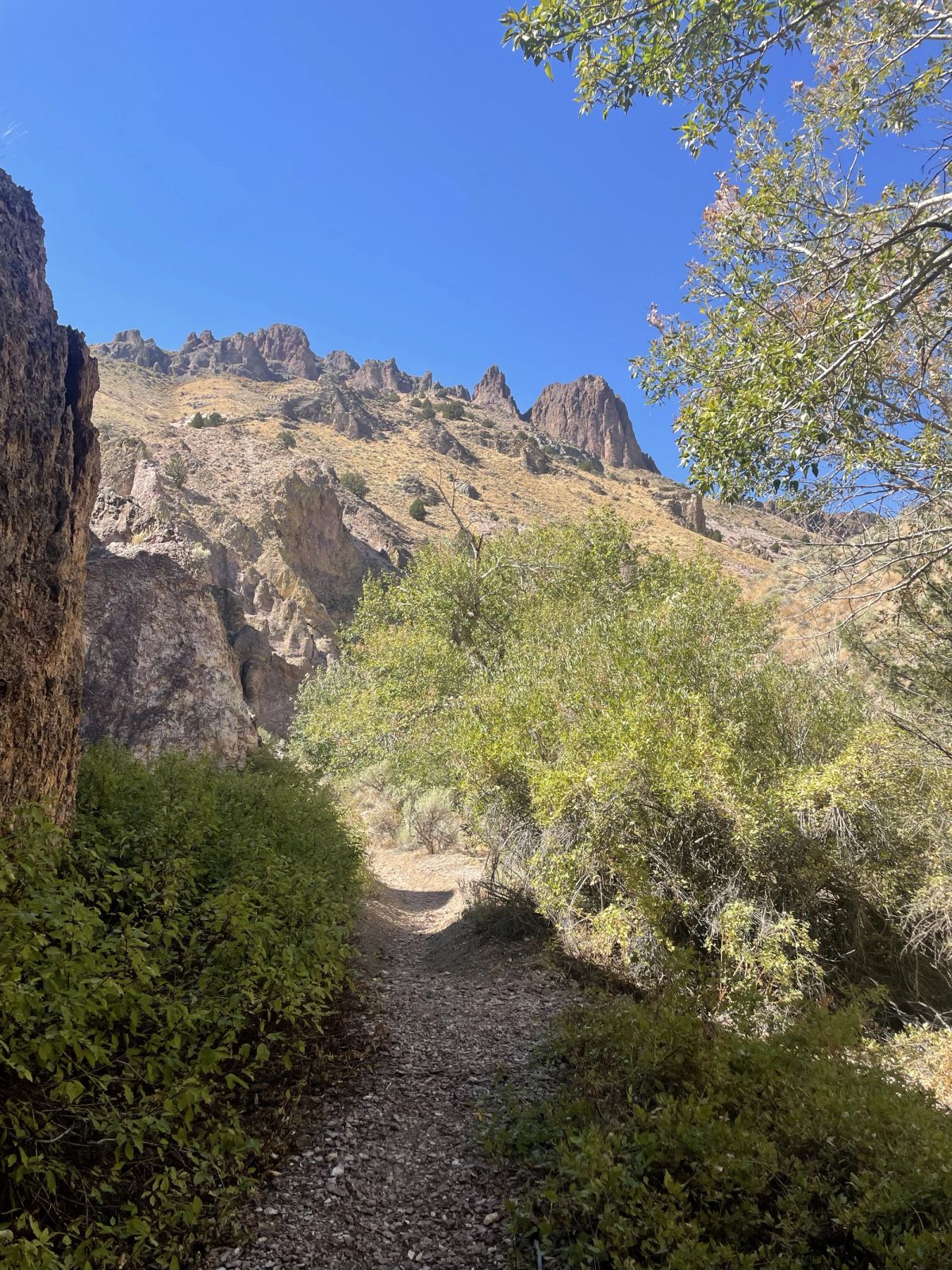
There is something strange about admitting that the place where I feel this most strongly is also one of the most barren places I know. There is almost nothing there that we ordinarily mean when we speak of home - no neighborhood, no familiar faces, no domestic life gathering around me. It's about as far from the experience of New York City as you could possibly experience - that's accessible by road. There is nothing to distract you from yourself. I keep going back, not because I wanted to disappear, but because something in that emptiness and space seems to return and keep growing within me. To me, it's the closest a place feels like home. I don’t think I can explain it much better than that.
Where Feels Like Home?
Not long ago, an acquaintance who knows that I moved a lot asked me, "Where feels like home?" A fair, if not basic question, but it hit me with a truely existential quality that I did not really know how to answer - at least in a way I felt they could comprehend. I said as I usually do, “wherever my things and friends are”, but my real answer is, I feel most at home in myself.
We usually ask people where someone’s from or feels like home, which is most often a question about geography and biography and can be answered with the names of cities and states. Where feels like home is another question altogether. It invites reflection and asks for experience. What is it that we are actually describing when asked what feels like home? Is it a place, or a person? What was that feeling of home when we were children, before we had enough life behind us to know that other homes could feel different from our own? What has it become since? And perhaps most revealingly, what do we still long for it to be?
Home is one of those words we tend to leave unquestioned because it seems so ordinary. Yet for many people the place called home was not especially comforting. It may have been lonely or uncertain, disruptive, volatile, emotionally thin, full of people but strangely empty of company. Others remember childhood as happy, or good, or normal, although normal is one of those words whose meaning changes considerably after enough years of examination have passed. A person can spend much of adult life carrying an uncomplicated story about the family they came from before noticing the absences inside it: how rarely anyone asked what they were thinking, how often distress went unseen, how much of childhood was spent monitoring the emotional weather of the house or learning not to need what was unlikely to arrive. A child, after all, unless they’ve spent a good amount of time spending the night with friends or relatives, have no other childhood against which to compare. Whatever happens there is not at first neglect or attention, closeness or distance. It is simply the world. We make a home from what we are born into and given.
Maybe that is why the word contains so much longing. We do not only remember homes; we spend our lives making, remaking, or resigning to the only one we think we’ll ever get. Sometimes home becomes a bookshelf slowly filled over years - of course arranged by color, artwork carried from one apartment to another each from its own season of life, the comfort of that denim or red-flannel shirt in the doorway in Fall, the small ritual of placing a record on a turntable and waiting for the first crackle before the music begins. There are objects that tell us we are somewhere familiar because they have traveled with us long enough to become part of the scenery of ourselves. But I have moved too many times to completely confuse home with a room. Rooms disappear. Stuff is lost or given away. Houses are sold. Cities change. People leave them.
What I have come to trust more and seek is something harder to name: the possibility of becoming a place in which one can live - coming to inhabit ourselves.
That sounds dangerously close to the language of self-sufficiency, and I do not mean it that way. We all need somewhere, and someone, through whom we feel accompanied and come to know and experience ourselves more. We need the sense that there is a place for what happens inside us, that our feelings do not make us intolerable, that our thoughts are worth hearing, that our existence does not have to be continually defended. None of us creates this entirely on our own - no one. Whatever inner home we eventually possess is built through relationship. Other people help furnish it. Their interest and disinterests, patience and intolerance, curiosity and orthodoxies, affection and judgements, and their willingness to remain however they may be become part of what makes an inside life. As we get older, continuing to build and remodel that home is also, in its own way, a solitary task - no one else can do or finish it for us.
In honesty, you have to separate yourself from the impersonal mass - you are saved from conformism. To be honest is to be lonely in the sense that you individuate yourself, you seize the moment to be yourself and yourself alone. There is an initial loneliness about being oneself, speaking out of ones center.
-Rollo May, One Mans Passage in Freedom and Destiny, p.48-49.
It can take years to build and remodel such a place. Perhaps a lifetime. And perhaps one of the stranger discoveries along the way is that some of the people who helped build it were never the people who lived in the house we first called home.
A Country Someone Helped Prepare
That discovery is nowhere clearer to me than sitting across from people still building that place inside themselves, like with someone I’ll call Jack. Jack isn't any single patient so much as an experience I recognize again and again — a very common presentation in the people who find their way into psychotherapy: someone who grew up in a home with very little emotional sustenance to live on, hard to reach emotionally, trapped in the voice of an unavailable father and a "loving" but tyrannical mother. But for one of these patients, something more specific happened. When he looks back now, one of the people he returns to most often is his tenth-grade English teacher, whom I will call Bill.
Bill was a real rascal of a teacher and a truly jolly person. The other teachers did not especially like Bill, but they tolerated him because the students loved him. He had that type of beard you’d see on English sailors in the 1800s with a curled-end handlebar mustache. He was a bit rebellious and seemed to understand that what happened in an English classroom could matter for reasons having very little to do with the assigned curriculum. He assigned books he thought might leave a mark. He asked questions that wandered beyond whatever lesson plan he was supposed to be following. Jack was an invisible student with a stutter. For reasons Jack is still coming to understand, Bill took an interest in him. He began inviting him to lunch, and they would talk. He gave him books in addition to those assigned for the class, such as Perks of Being a Wallflower, Tuesdays with Morrie, and The Giver. Then asked what he thought of them and what they made him feel. He treated Jack's interior life as valuable, important, and worth discovering.
About halfway through the semester, Bill became ill and was no longer able to teach, but he continued to come to the school to see Jack. On his last day, he gave Jack his phone number. Something that would never happen today. They would speak a few times a year. Then, some five years later, around Christmas, Jack called him. Bill's daughter answered the phone. He had died, and the family had gathered at his house for one last Christmas before they sold it. My patient had the chance to tell her what her father had meant to him: that during a period of his life when very few people seemed interested in who he was or cared who he was becoming, Bill had seen something in him and, by seeing it, helped cultivate, sustain, and keep some part of him alive.
What another person gives us is not always something we can separate from who we become because of their presence. Harry Stack Sullivan understood the self as something formed in the interpersonal world, not first in isolation as a pre-formed “self” and only later brought into relationship. An idea that has shaped and become foundational in nearly all schools of psychology and is supported by modern neuroscience. We’re not a fully cooked loaf of bread in arriving to life, but like a smoothie, and those first few ingredients go a long way. We learn and become who we are in relationship. Someone looks at us as though there is something worth knowing, and slowly we begin to feel like we’re someone worth knowing. Someone regards our thoughts as worth taking in, experiencing, and continuing the conversation, and eventually a mind that had learned to go quiet may begin to risk saying more.
If that happens often enough—or, in some lives, intensely enough—the experience does not simply disappear when the relationship ends. Some people stay with us in ways that are inseparable from who we have become. It is not only that we remember them, though memory matters. We take in something of how they were with us. Someone who listened closely leaves us with a way of listening. Someone who was curious about us leaves us with the possibility of curiosity. Someone who saw life in us when very little around us reflected it back can become part of what helps that life keep growing. A way of being with another person gradually becomes one of the ways we can be with ourselves. This is one of the quieter things that happens between people: we usually notice relationships while they are present, but sometimes their deepest effects become visible only after the person is gone.
Psychoanalysis has more technical language for all of this, but I am not sure that language helps further one along the journey. We are inhabited by people - our experiences of them. Some of them become harsh voices against which we spend years, or even a whole lifetime, defending ourselves. Others are quieter and can be more difficult to find. They are the ones who looked at us without contempt, who remained interested, who made room for a feeling rather than turning away from it. As a clinician, I’ve found these are often almost out of conscious awareness, protected because of how sustaining any bit of life in the person. Their presence can be faint at first, especially when it must compete with older and louder forms of judgment. But given enough attention, enough relationship, perhaps enough years, the scales begin to tip, and these figures become more dominant parts of what sustains us. We begin to carry within ourselves some version of the person who once carried something for us.
Lisa Director writes about this in describing a patient whose inner life was dominated by the presence of a dismissive father, while another man from his youth - someone who had once met him with understanding rather than condemnation - remained much quieter inside him. Part of the work was not simply to remember this other man, but to make more room for what his way of relating had made possible. Making more room and allowing that experience to grow. Director describes how a mind comes to regard its own thoughts as worth hearing because those thoughts were first given importance by someone willing to listen.
This is what I see in Jack and Bill’s story. He died nearly twenty years ago, but something he did still gives life to Jack, even if it’s hidden in protection inside him. Bill isn’t there anymore, but some part of his care remains. That’s one of the greatest gifts someone can give us: not just the feeling that we mattered to them, but to take in that sense of ourselves long after they’re gone. Some people become part of the ground beneath us that the rest of who we are is supported.
The Frontier of Belonging
This is part of what I mean when I say I’m grateful to feel at home in myself. I don’t mean I’ve reached a point where I need no one, or that being alone is better than being with others. There are plenty of times when my first instinct is to turn to someone and say, “Look!” or reach for a ready hand. This is one of the loneliest parts of going through transformative changes - there is generally only one person who gets to witness it. Wanting someone there doesn’t go away just because you’ve come to enjoy your own mind and company. If anything, solitude can make that wanting clearer. But wanting company and feeling abandoned aren’t the same. Rilke believed that learning to love takes a long education in solitude—not because love makes us self-sufficient, but because another person cannot be asked to relieve us of the work of becoming someone capable of meeting them. For in solitude and silence we come to love what is most essential - ourselves. This, I believe, is what May meant by freedom: not the absence of others, but the presence of a self capable of being alone with itself. This clarity and self-assurance of one's self-accompanyment certainly don't make life less painful. But the lived, emotional body in which the feelings and experience of life are held is stronger, more gracious, and more capable.
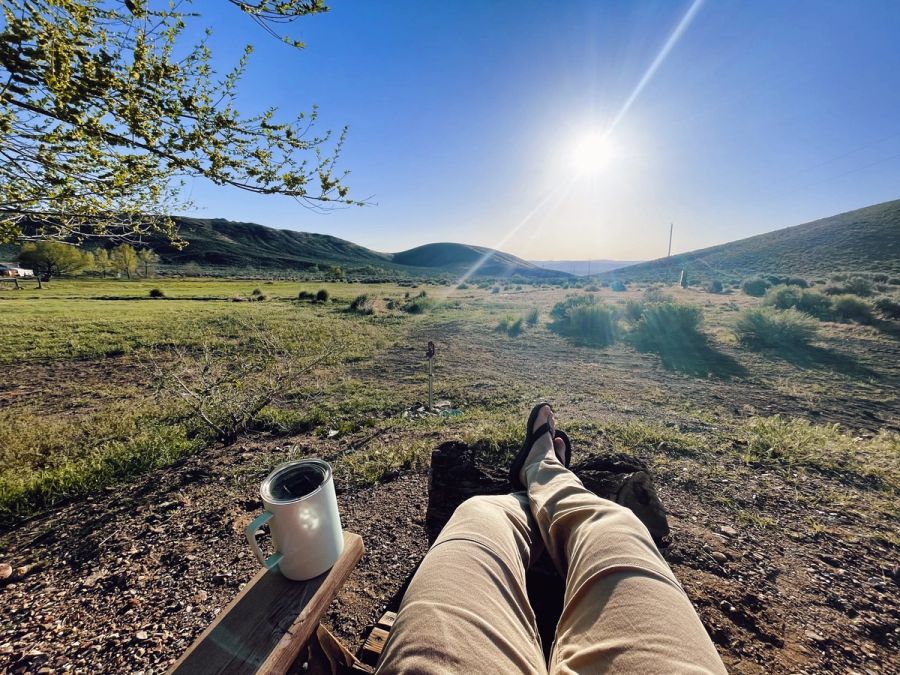
Even in these moments of deep solitude — gazing out at the sunrise, coffee in hand — there is a support in the vast bareness of the landscape. A tingling moves through my spine and down my arms. My stomach relaxes, my shoulders release, and I'm able to take a deep breath all the way down. This place comes with me. Whether at home, walking back through the streets of New York City after a day's work, or simply sitting still — I can be with my internal world. Thoughts and feelings move like wind through a pair of chimes, striking against each other, making their sound. Nothing holds them back. Or nothing I'm aware of, anyway.
With their whole being, with all their forces, gathered around their solitary, anxious, upward-beating heart, they must learn to love. But learning-time is always a long, secluded time, and therefore loving, for a long time ahead and far on into life, is: solitude, a heightened and deepened kind of aloneness for the person who loves.
- Rilke, Letters to a Young Poet, Letter 7
This relationship wasn’t built by me alone. We become who we are, for better or worse, because of other people. We learn about ourselves from the faces that turn toward us and those that don’t. When someone takes an interest in us, we become interesting for a while. When someone listens closely, we start to believe there’s something inside us worth hearing. If we’re lucky, these ways of being seen become part of who we are. People move away, relationships end, therapists retire, and teachers pass on. But something from those relationships stays with us. With the care, attention, and freedom from another, we keep building this inner place by asking and being asked: what is this like?
When I drive to or leave here, I always listen to Mark Isham's score from the movie A River Runs Through It. Intuitively, I’ve felt it belongs there so naturally. There is something so graciously moving and a sorrow that's embracing in the music. It seems to carry loss, love, and adventure together, as though the heart has been hurt badly enough to know what has been lost and has nevertheless begun to move again in the larger life of the prairie. The road begins to widen, the sage thins, more cars begin to pass, and the houses become closer together and newer until the long view of the prairie is washed out. But the place and the people of our past are always within.
The country remains what it has always been: indifferent, exposed, beautiful, and unwilling to make any promises. It does not tell you who you are. It does not reassure you you're loved. It does not even know who you are. It offers itself — an immense space to unfurl, to listen within, to let go of what no longer serves. And somewhere in that offering is the same gracious, sorrowful embrace I hear driving in, and driving out, in Mark Isham's music. These are moments that cannot last, but I take the memory of the spaciousness of the prairie with me. That place that asks nothing of me, and in asking nothing, leaves room for everything else to simply be there.
Bio:
My name is Caleb Dodson. I’m a private psychotherapist in Manhattan, New York, and online in Washington State. I’m finishing my dissertation on the therapist's experience of authenticity and a new psychoanalyst in training at The Manhattan Institute of Psychoanalysis. I’m most passionate about bringing kindness to and excavating a sense of shared humanity to some of life’s most challenging experiences, in the service of a fuller life.
Source notes:
Director, L. (2016). "The Analyst as Catalyst: Cultivating Mind in the Shadow of Neglect," Psychoanalytic Dialogues, 26(6). 685-697.
Lionells, M. (2000), “Sullivan’s Anticipation of the Postmodern Turn in Psychoanalysis,” Contemporary Psychoanalysis, 36(3), 393–410.
May, R. (1981). Freedom and destiny. Norton.
Rilke, R. M. (2021). Letters to a young poet (A. Barrows & J. Macy, Trans.). Shambhala.
Comments
0 approved
No approved comments yet. Be the first to start the conversation.